In moments of decision, transition, or uncertainty, we often return to deeper questions: Do people experience our leadership as trustworthy? Do our decisions create confidence, clarity, and care? Are we becoming the kind of leaders people can trust when pressure rises? These are not only strategic questions; they are human ones. The qualities we seek in public leadership — character, humility, accountability, wisdom, and courage — are the same qualities required of every leader entrusted with people, decisions, and the outcomes their choices will shape. Leadership, at its best, is stewardship before it is strategy.
Most leaders believe they are trustworthy. The deeper question is whether their leadership is experienced that way by the people, teams, and cultures shaped by their decisions.
Key leadership questions this raises: Are people experiencing my leadership the way I intend? Where might my behavior be creating or eroding trust? What is my leadership forming in the culture around me? And how can I steward my influence so people, teams, and organizations are strengthened over time?
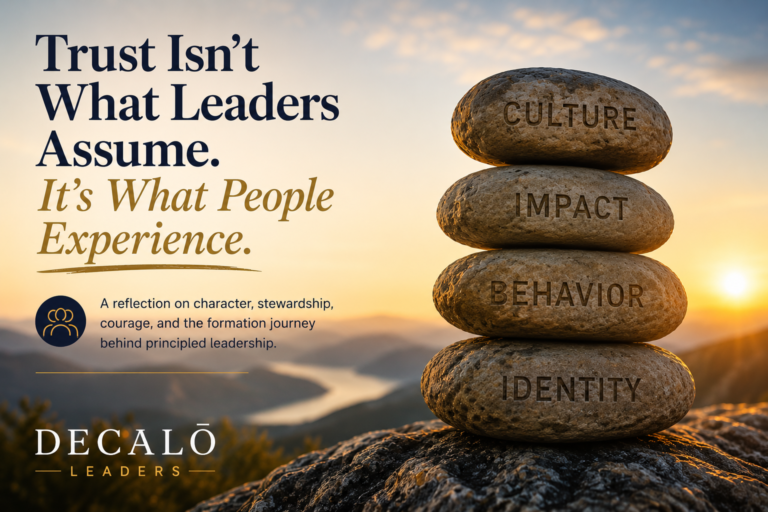
At Decalō Leaders, we believe leadership is not merely a set of competencies to master. It is a formation journey — the ongoing shaping of a leader’s inner life, daily behavior, and outward influence — one that moves through four connected arcs:
Identity → Behavior → Impact → Culture
Seen through this lens, these traits are not isolated virtues. They are evidence of formation — internal, behavioral, relational, and cultural — and of how faithfully a leader stewards the influence entrusted to them.
1. Identity: Character Is the Leadership Foundation
Character belongs to the first movement of the Decalō curriculum: Identity.
Character is not performance. It is the internal center that holds when pressure rises. A leader’s steadiness, clarity, wisdom, and moral grounding flow from who they are, not simply from what they project. Over time, the inner life of a leader becomes visible in the way they serve, decide, and carry responsibility.
In Decalō’s Identity modules, leaders explore:
Character is the root system of leadership. Without it, influence becomes fragile; with it, leadership becomes grounded, trustworthy, and worthy of the responsibility it carries.
2. Behavior: Learning From Mistakes and Practicing Accountability
Two leadership behaviors reveal formation with particular clarity: learning from mistakes and practicing accountability.
These behaviors sit squarely in the second movement of the Decalō curriculum: Behavior.
Leaders who learn from mistakes demonstrate humility, maturity, and emotional steadiness. Leaders who practice accountability demonstrate ownership, clarity, and trustworthiness. Together, these behaviors help organizations move from blame to learning, from confusion to clarity, and from repeated missteps to wiser action.
For example, when a team misses an important milestone, a leader shaped by humility and accountability does not assign blame, minimize the issue, or protect their reputation. They name the gap, own their role first, invite honest learning, and help the team agree on the next right actions. In that moment, accountability becomes more than a stated value — it becomes humility in practice and trust in motion.
In Decalō’s Behavior modules, leaders practice:
Behavior is identity expressed through action. It is where internal formation becomes visible and where a leader’s values are tested in the ordinary moments of responsibility.
3. Impact: Courage That Changes Outcomes
Courage is not always loud or dramatic. Often, it is quiet clarity expressed through action — especially when the stakes are high, the pressure is real, and the cost is personal. Moral courage asks leaders to act in alignment with what is right, even when the easier path is available.
This is the third movement of the Decalō curriculum: Impact.
A president’s courage shapes national direction. A leader’s courage shapes organizational outcomes. In both cases, courage determines whether decisions create progress, stability, repair, or transformation — and whether influence is used for self-preservation or for the good of the people and systems entrusted to their care.
In Decalō’s Impact modules, leaders learn to:
Impact is the result of identity-driven behavior. It is what happens when who a leader is and how a leader acts begin to shape what becomes possible for others. At its best, impact is influence stewarded toward repair, growth, and human flourishing.
4. Culture: What Leadership Creates Over Time
Leadership always creates culture — intentionally or unintentionally. Every leader is stewarding an environment where people become more whole, more courageous, and more capable of trust, or less so.
This is the fourth movement of the Decalō curriculum: Culture.
A president’s character, learning posture, accountability, and courage become signals to a nation. A leader’s daily behaviors become signals to a team. Over time, those signals shape norms, expectations, trust, and emotional climate. Culture becomes the shared environment people inhabit — and leaders are responsible for what that environment forms in others.
In Decalō’s Culture modules, leaders explore:
Culture is the long-term echo of identity, behavior, and impact. It is what remains after individual decisions become shared expectations and influence has been stewarded over time.
The question, then, is not only what kind of leader succeeds in a visible role. The Decalō lens invites us to ask something deeper:
What kind of formation produces a leader people can trust, follow, and flourish under?
Character, learning, accountability, wisdom, and courage are not isolated traits. They are expressions of a leader’s formation journey — the visible evidence of identity becoming behavior, behavior creating impact, and impact shaping culture.
This is the heart of principled leadership. This is the work of formation. And this is the work Decalō Leaders exists to cultivate: leaders whose presence builds trust, whose choices create impact, and whose influence stewards cultures where people can thrive.
What kind of leadership is your culture currently forming? If you are ready to strengthen leaders whose inner lives and outer impact are aligned, Decalō Leaders offers a formation pathway that moves beyond performance to principled leadership people can trust. Begin the conversation about how identity-shaped leadership can steward lasting impact, cultivate wisdom, and form a culture where people do more than perform — they flourish.
This reflection was inspired by the Apple News article “What Kind of Leader Makes for a Great President?”