
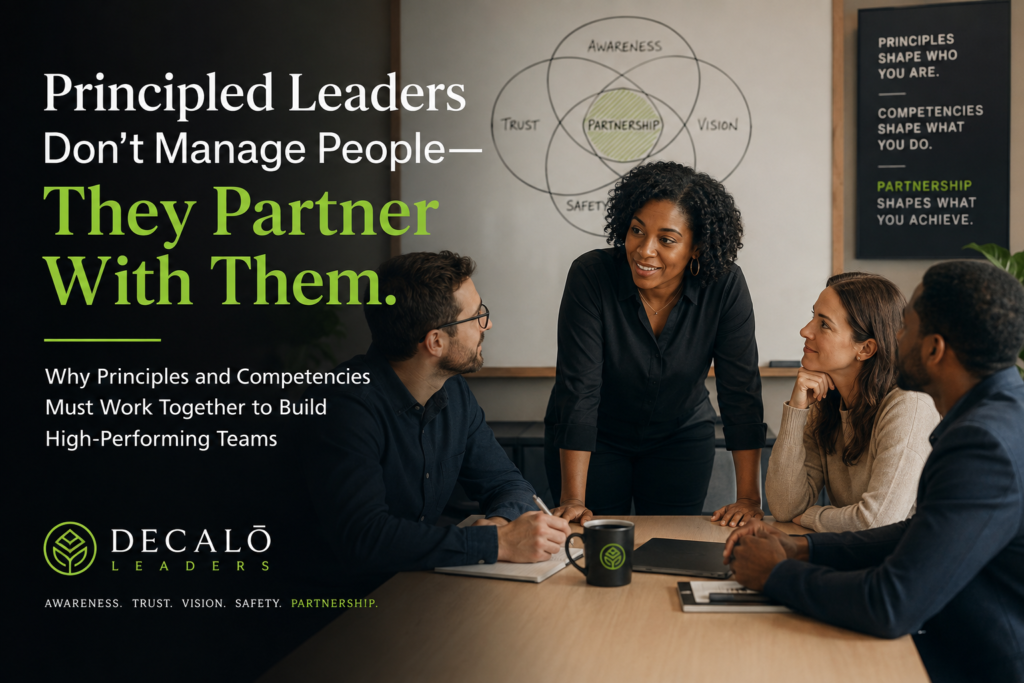
In every organization, there comes a moment when technical skill is no longer enough.
For directors, that moment often arrives when your scope expands from execution to influence: multiple teams, cross-functional dependencies, competing priorities, and a steady stream of ambiguous decisions. At that level, your presence—not your task list— becomes the deciding factor in whether teams align and thrive or splinter and stall.
This is the moment when the distinction between principles and competencies becomes more than a matter of leadership theory. It becomes the hinge on which performance, trust, and culture turn. And at the director-level, people notice your response to pressure—your boundaries, your steadiness, and how you hold the line with both partnership and authority.
High-performing leaders don’t rely on competencies alone. They anchor themselves in principles that shape identity, guide behavior, and create the conditions where partnership—not control—becomes the norm. For director-level leaders, partnership has to scale: it shows up in how you set direction, develop other leaders, earn trust with peers and executives, and protect the health and focus of your teams.
Principles: The Identity of a Leader
Principles answer the question: Who are you when the pressure is on?
They are the internal commitments that shape how a leader shows up long before they choose a strategy or skill. In the Decalō framework, those commitments are anchored in awareness, trust, vision, and psychological safety—and they show up as a leader’s steadiness, clarity, and consistency. Principles are:
At Decalō, leaders are grounded in principles such as awareness (knowing one’s impact on others), trust (modeling expertise, demonstrating benevolence, and practicing integrity), vision (setting a direction people can commit to), and psychological safety (creating space for candor, learning, and healthy dissent). That foundation makes partnership possible. Team members don’t have to guess who the leader will be today. They can trust the ground they’re standing on. At the director level, that trust is reinforced by clear decision rights, transparent trade-offs, and consistent escalation paths—so people know when to move fast, when to align, and how to disagree well.
Competencies: The Expression of Leadership
Competencies answer the question: How do you translate your principles into
action?
They are the observable skills that make leadership practical and measurable.
Competencies are:
Competencies—feedback, alignment, coaching, and clear decision-making—are the tools leaders use to operationalize their principles.
Example phrases (competencies in action)
Without competencies, principles remain aspirational.
Without principles, competencies become mechanical.
High-performing leaders need both.
Where Principles and Competencies Meet: Partnership
Partnership is not a soft skill. It is a performance strategy. Teams perform at their highest level when leaders:
Try this (director-level partnership behaviors):
When principles shape identity and competencies shape behavior, leaders stop managing tasks and start partnering with people. At the director level, that partnership shows up in how you sponsor leaders, remove systemic friction, and negotiate priorities across the enterprise—not just within your org chart. You create an environment where people feel seen, supported, and responsible for the mission—not just compliant with
instructions.
This is the difference between a team that performs and a team that thrives.
The Leaders People Choose
The leaders people choose to follow are not simply skilled. They are principled. They are grounded. They are consistent. Their competencies are not disconnected tactics—they are the natural expression of who they are.
When leaders integrate principles and competencies, they:
This is the work of high-performing leadership.
This is the work of partnership.
This is the work of principled leaders.
If this resonates, share it with a leader you respect—and pick one phrase or behavior above to practice this week. I’d love to hear: Where are you shifting from managing to partnering right now? Reply with the principle you’re practicing.
As you lead at scale, consider:
1) Where do my teams need more clarity—priorities, decision rights, or trade-offs?
2) Which competency would most amplify the Decalō principles I’m leaning on right now (awareness, trust, vision, psychological safety)?
3) What would partnering (not managing) look like in my hardest relationship this quarter?