
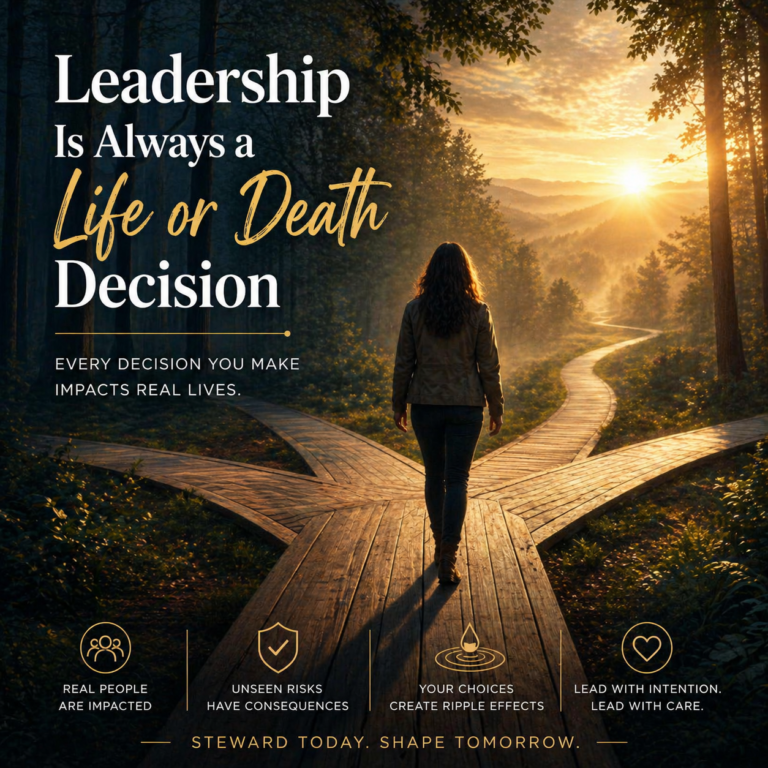
When I was growing as a leader, I often heard a familiar refrain: “It’s not life or death.” It was meant to steady the room, to signal that the stakes weren’t as high as they felt.
But over time, I learned a truth we rarely name: leadership is always lifeordeath work — because leadership always impacts people’s lives.
Sometimes literally.
In some environments, the consequences aren’t immediately visible. It can look like we’re simply making operational choices or balancing priorities. But every decision a leader makes shapes someone’s livelihood, well-being, sense of safety, or ability to thrive. That is life-changing. Sometimes life-altering. And in certain industries, life-threatening.
I learned this at Amtrak, MedStar, NIH, and the FDA — places where a single decision can ripple into public safety, patient outcomes, or national health. The same is true in the military, law enforcement, air traffic control, and countless other fields where clarity, courage, and discipline aren’t optional; they’re required.
Leadership is never “just business.” It’s stewardship. It’s identity expressed through behavior. It’s the weight of knowing that what you choose, what you ignore, and how you show up will impact real people in real ways.
And the stakes don’t always announce themselves. They hide inside timelines, budgets, org design, and the tone you set in rooms you may only enter for an hour. Those choices determine how safe people feel to speak up, how sustainable the work becomes, and whether a system quietly erodes or intentionally improves.
Below are everyday scenarios where the life-or-death weight of leadership shows up — not in drama, but in the human cost of our decisions.
As you read these, ask yourself: What am I optimizing for — and who bears the cost if I’m wrong?
Across all of these, the decision is only half the work. The other half is making the impact visible — naming tradeoffs, protecting the people doing the work, and setting standards you’re willing to defend when pressure comes.
That’s why a lightweight checklist can be so powerful: it slows you down just enough to widen the lens, surface risk early, and communicate in a way that helps teams execute with clarity. Here’s a quick pre-flight to support your decision-making process.
So, the next time someone says, “It’s not life or death,” take it as an invitation to look again. Your decisions set pace, standards, and signals — what gets protected, what gets normalized, and what people believe is safe to name.
Use the scenarios to spot the hidden costs. Use the checklist to widen the lens. And then make the call in a way you’d be proud to stand behind — because the impact is always real, even when it isn’t immediately visible.
When leaders understand the human cost of their decisions, they lead differently — with greater humility, greater intention, and greater care. That’s the kind of leadership our world needs more of.