
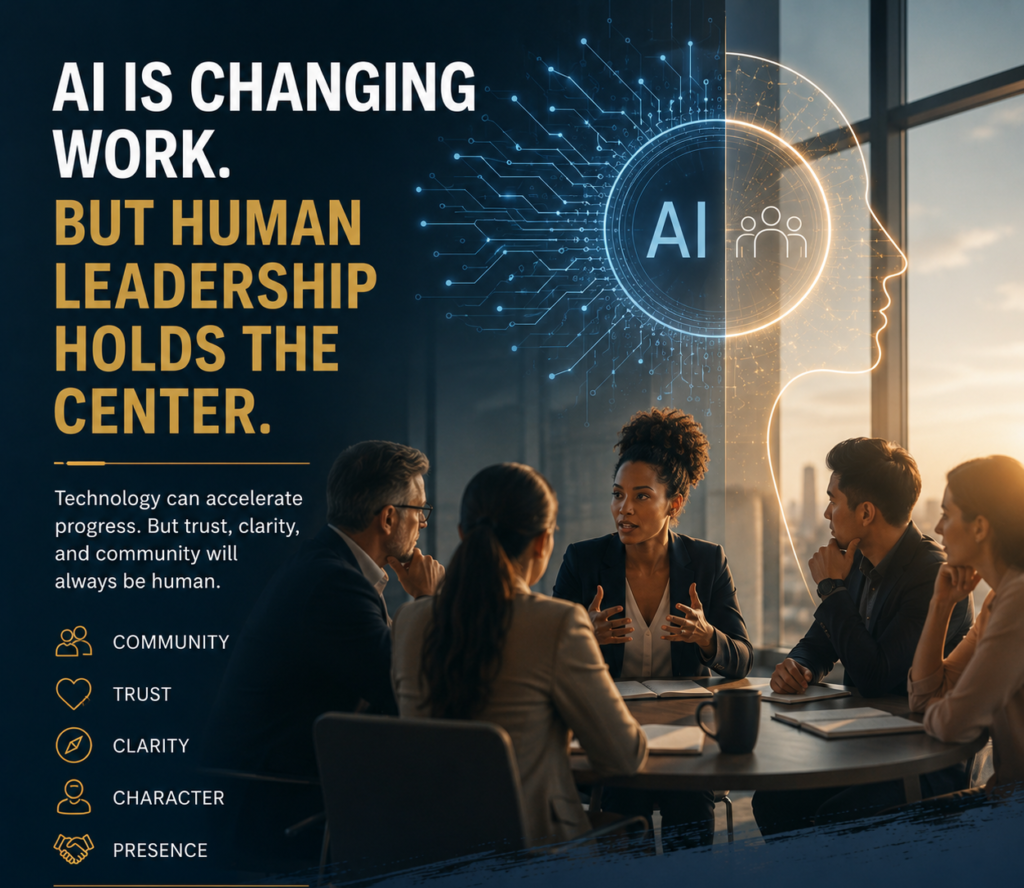
Let’s start with the fear: AI is accelerating. It is learning faster, producing faster, and reshaping the way we work, decide, communicate, and compete.
So the question is no longer whether AI will change leadership. It will. The sharper question is this: If leadership is fundamentally relational, does AI make leadership obsolete?
The answer is simple: only if we have confused leadership with output.
Leadership is not a technology problem. It is a human survival strategy.
For all of human history, community has been our operating system. Before strategy decks, performance dashboards, management theories, or AI tools, humans survived because we gathered, collaborated, protected one another, shared responsibility, and built meaning together.
Community was not optional. It was oxygen.
That is what leaders must remember: humans have always needed community to survive. That will not change — not now, not with AI, not ever.
AI can disrupt industries. It cannot disrupt human need.
AI can generate clarity, but it cannot embody it. Nor can it confirm it.
Clarity is not merely a well-written sentence, a compelling framework, or a repeated message. Clarity is a lived reality inside a community, confirmed by relationship, trust, and shared meaning.
Clarity is not proven by the message. It is proven by the leader who lives the message.
AI can help write the script. Only humans can live it.
AI can help leaders teach community — but it cannot build community.
Teaching is about content. Building is about connection. AI can articulate shared language, reinforce values, generate learning materials, and scale communication. But it cannot create trust, belonging, shared identity, sacrifice, or collective memory.
Because community is not formed by information. Community is formed by relationships.
AI can scale output. It cannot scale trust.
Trust is slow. It is earned through consistency, presence, vulnerability, shared experience, and accountability.
AI can simulate empathy, but it cannot experience it. It can produce insight, but it cannot carry it. It can support a leader, but it cannot be one.
Leaders are not followed because they know more. Leaders are followed because people trust who they are.
That is not automatable.
Community is the irreplaceable infrastructure of leadership.
Community is where leaders are formed, challenged, refined, held accountable, and reminded of who they are. It is where identity becomes behavior.
AI can help leaders communicate with community, organize community, and teach community. But it cannot be community.
AI doesn’t make leadership obsolete. It exposes hollow leadership.
The only leadership AI threatens is the kind that was already fragile: transactional leadership, performative leadership, output-obsessed leadership, and leadership built on charisma instead of character.
In an AI-accelerated world, the leaders who thrive will be the ones who are most deeply human.
The future belongs to leaders anchored in community.
As AI increases speed, humans will crave grounding, belonging, trust, shared meaning, and relational stability.
AI raises the bar on technical competence. But it raises the stakes on human competence: identity formation, emotional maturity, relational stewardship, accountability, and embodied clarity.
These leaders will not be replaced. They will be sought out.
So what should leaders do now?
Respond to AI by becoming more fully human: more relationally grounded, more present, more discerning, and more disciplined in the formation of trust.
Leadership after AI
AI is not the threat. Disembodied leadership is.
If leadership is relational, AI does not make leadership obsolete. It makes leadership more necessary, more visible, and more accountable.
Because when everything else becomes automated, accelerated, and optimized, people will not be looking for leaders who can merely produce more. They will be looking for leaders who can be trusted with meaning, belonging, clarity, and care.
That is the leadership AI cannot replace: not louder, not faster, not more polished — but embodied, accountable, relationally grounded, and worthy of trust.
Begin there: around the table, in the hard conversation, in the moment a leader chooses presence over performance, courage over control, and community over isolation. Start with the people entrusted to you. Do not wait for the next tool to solve what only trust can heal. Ask where trust has thinned. Name where clarity has become noise. Rebuild belonging one honest practice at a time. If that is the work you are carrying, Decalō Leaders would be honored to walk alongside you. We would welcome your reflections: Where are you seeing the need for more deeply human leadership in this AI- accelerated moment?